
Last Updated: November 2026
Quick answer: Hallasan hiking comes down to one choice: summit or no summit. Only two trails reach the 1,947 m crater of Baengnokdam — Seongpanak (9.6 km, about 4.5 hours up) and Gwaneumsa (8.7 km, about 5 hours up) — and both need a free online reservation for the final stretch, released from 9:00am on the first business day of the previous month. The other trails, Yeongsil and Eorimok, need no booking and reach Witse Oreum (1,700 m) in 1.5–2 hours. From October to March, summit-trail gates close at 11:30am, so plan to start by 7am.
Hallasan is the volcano that is Jeju Island — every road on the island climbs toward it, and on a clear day you can see it from almost anywhere. It is South Korea’s highest mountain, and the core of the UNESCO-listed Jeju Volcanic Island and Lava Tubes site. It’s also one of the most practical big hikes in Asia: there are no technical sections, the trails are well built, and city buses drop you at the trailheads.
The catch is the rules. Summit access is booked, every gate has a closing time, and those closing times move earlier from October to March. This is when most visitors want to go, because the snow on the upper slopes is the prettiest of the year. This guide covers the trails, the reservation, the winter timetable, how to get there by bus and what to carry. If you’re still planning the wider trip, start with our Jeju Island guide.

Table of Contents
- Which Hallasan trail should you hike?
- Do you need a reservation to hike Hallasan?
- What time do Hallasan trails close in winter?
- Is Hallasan worth hiking in the snow?
- How do you get to the Hallasan trailheads without a car?
- A realistic summit-day plan
- What should you pack?
- Fitting Hallasan into a Jeju trip
Which Hallasan trail should you hike?
Pick Seongpanak if you want the summit with the least strain, Gwaneumsa if you want the summit with the best scenery, and Yeongsil if you want the most dramatic views for the least time. Hallasan National Park lists seven trails. These are the official one-way distances and times from the Hallasan National Park trail page:
| Trail | One-way distance | Official time (one way) | Reaches | Booking |
|---|---|---|---|---|
| Seongpanak | 9.6 km | 3 h to Jindallaebat shelter · 4.5 h to summit | Baengnokdam summit | Required (Jindallaebat → summit) |
| Gwaneumsa | 8.7 km | 3 h 20 min to Samgakbong shelter · 5 h to summit | Baengnokdam summit | Required (Samgakbong → summit) |
| Yeongsil | 5.8 km | 1.5 h to Witse Oreum · 2.5 h to Nambyeok junction | Witse Oreum / south wall | None |
| Eorimok | 6.8 km | 2 h to Witse Oreum · 3 h to Nambyeok junction | Witse Oreum / south wall | None |
| Donnaeko | 7 km | 3.5 h to Nambyeok junction | South wall | None |
| Eoseungsaengak | 1.3 km | 30 min | Small crater peak | None |
| Seokguram | 1.5 km | 50 min | Hermitage in a forest valley | None |
Seongpanak vs Gwaneumsa: which way to the summit?
Seongpanak is the gentler climb. It’s long, but most of it is a steady forest path, and it’s the route most first-timers book. Gwaneumsa is shorter on paper but steeper. It runs along the Tamna Valley and past the sharp rock spire of Samgakbong, so it’s the more scenic of the two, and harder on the knees. The park’s own FAQ suggests going up Seongpanak and down Gwaneumsa if you’re fit, but it warns that this makes a 10-hour day. In winter, when the days are short, only do it in a group.
Gwaneumsa only reopened all the way to the summit on September 24, 2026, after construction work, according to the park’s reopening notice. Both summit routes are bookable again this winter.
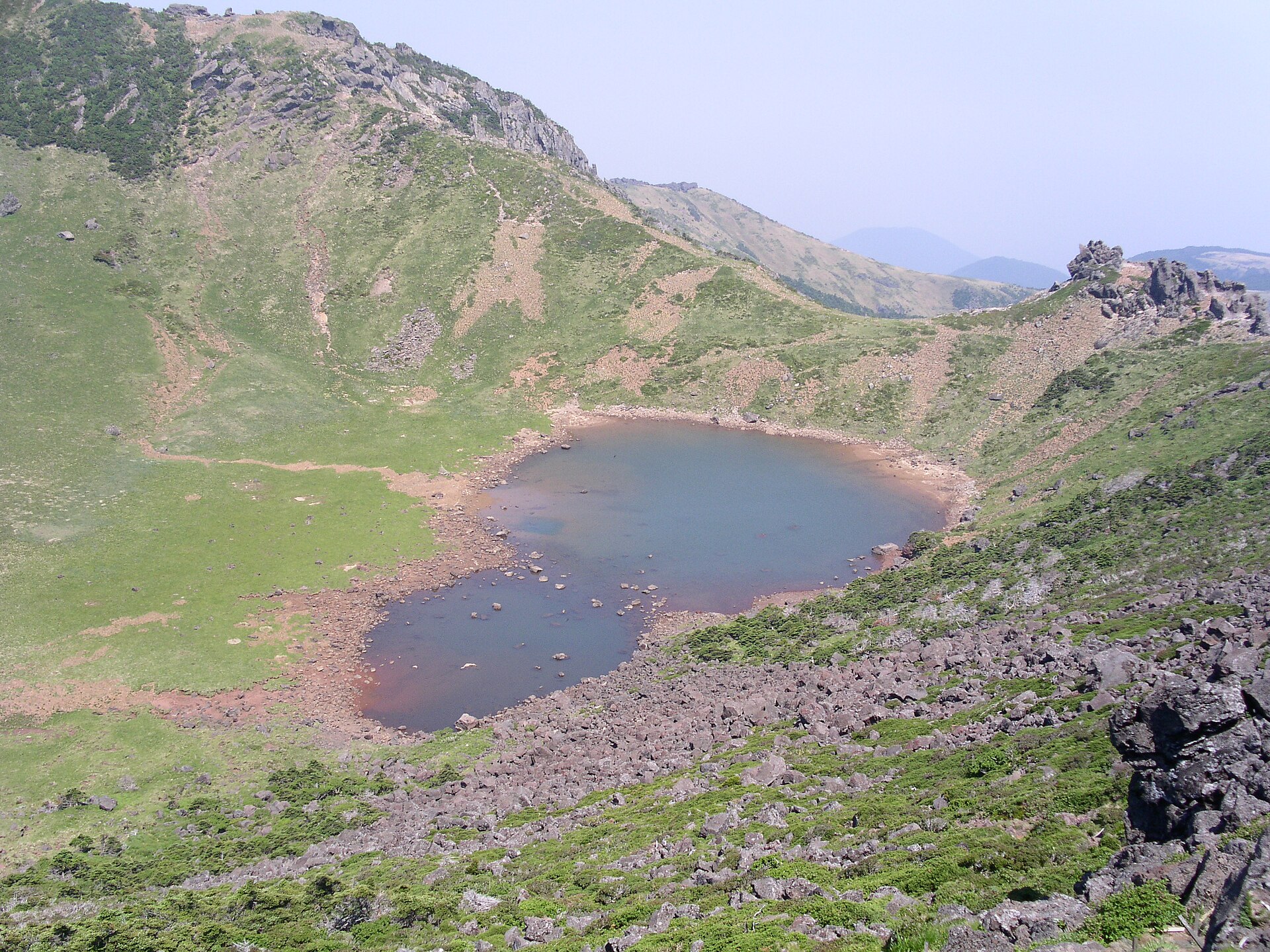
Is Yeongsil worth it if you skip the summit?
Yes, and for many visitors it’s the better day. The climb from the Yeongsil rest area to Witse Oreum takes about 1.5 hours, past the Yeongsil Giam rock pillars, then crosses an open alpine plateau with the summit dome in front of you. It doesn’t reach the crater, but you get the big views for a third of the effort. You can also walk down via Eorimok to make a one-way traverse. If you only have a morning, the 30-minute climb up Eoseungsaengak, next to the Eorimok visitor center, is the easiest real view of Hallasan.
Do you need a reservation to hike Hallasan?
Only for the summit section of Seongpanak and Gwaneumsa. Since May 2025 you can walk the lower parts of both trails without a booking: Seongpanak up to Jindallaebat shelter (7.3 km) and Gwaneumsa up to Samgakbong shelter (6 km). A reservation is checked at those shelters before you continue to the crater. Yeongsil, Eorimok, Donnaeko, Eoseungsaengak and Seokguram never need one.
Bookings are made on the Hallasan Trail Reservation System, which has an English version. These are the rules from the park’s reservation notice:
- When it opens: 9:00am KST on the first business day of the previous month. January hikes open in early December, February hikes in early January. Weekend slots in snow season go fast.
- Group size: up to 4 people per booking, and one booking per person per week.
- Your QR code: it’s sent to the phone number you enter and scanned at the trailhead and the shelter. Use a number that can receive Korean texts, or check the reservation in the system before you go.
- Cancel if you can’t go: you can cancel until the end of your booked entry slot. A no-show without cancelling bans you from booking for 3 months, and a second one for a year.
If you miss the booking window, don’t give up on the mountain. Yeongsil and Eorimok are walk-up trails, and in fresh snow the plateau at Witse Oreum is arguably the most beautiful place on Hallasan anyway.
What time do Hallasan trails close in winter?
From October through March, the summit gates on Seongpanak and Gwaneumsa close at 11:30am, and you must be off the crater rim by 1:30pm. All trails open at 5:00am. These are the winter times from the park’s 2026 seasonal-hours notice:
| Checkpoint | Winter (Oct–Mar) | Summer (Apr–Sep) |
|---|---|---|
| Seongpanak trailhead & Jindallaebat shelter — last entry | 11:30 | 12:30 |
| Gwaneumsa trailhead & Samgakbong shelter — last entry | 11:30 | 12:30 |
| Yeongsil & Eorimok trailheads — last entry | 12:00 | 15:00 |
| Witse Oreum (toward south wall) — last entry | 13:00 | 14:00 |
| Donnaeko trailhead — last entry | 10:00 | 11:00 |
| Summit (east rim) — leave by | 13:30 | 14:30 |
| Jindallaebat / Samgakbong shelters — leave by | 15:30 | 16:30 |
| Witse Oreum — leave by | 15:00 | 17:00 |
The trailhead time isn’t the one that matters most. The real deadline on Seongpanak is reaching Jindallaebat shelter by 11:30am, which is 7.3 km and about 3 official hours from the start. Walking slowly on snow, that means leaving the trailhead by 7:00–7:30am at the latest. Rangers turn back anyone who arrives late, booking or not.
The park can also close trails partly or completely during weather warnings. Its rules name heavy snow, strong wind (14 m/s or more), heavy rain, a cold wave, thick fog at altitude, or more than 30 cm of new snow in a day. Check the live trail status on the park homepage the morning you go, along with the mountain forecast from the Korea Meteorological Administration.
Is Hallasan worth hiking in the snow?
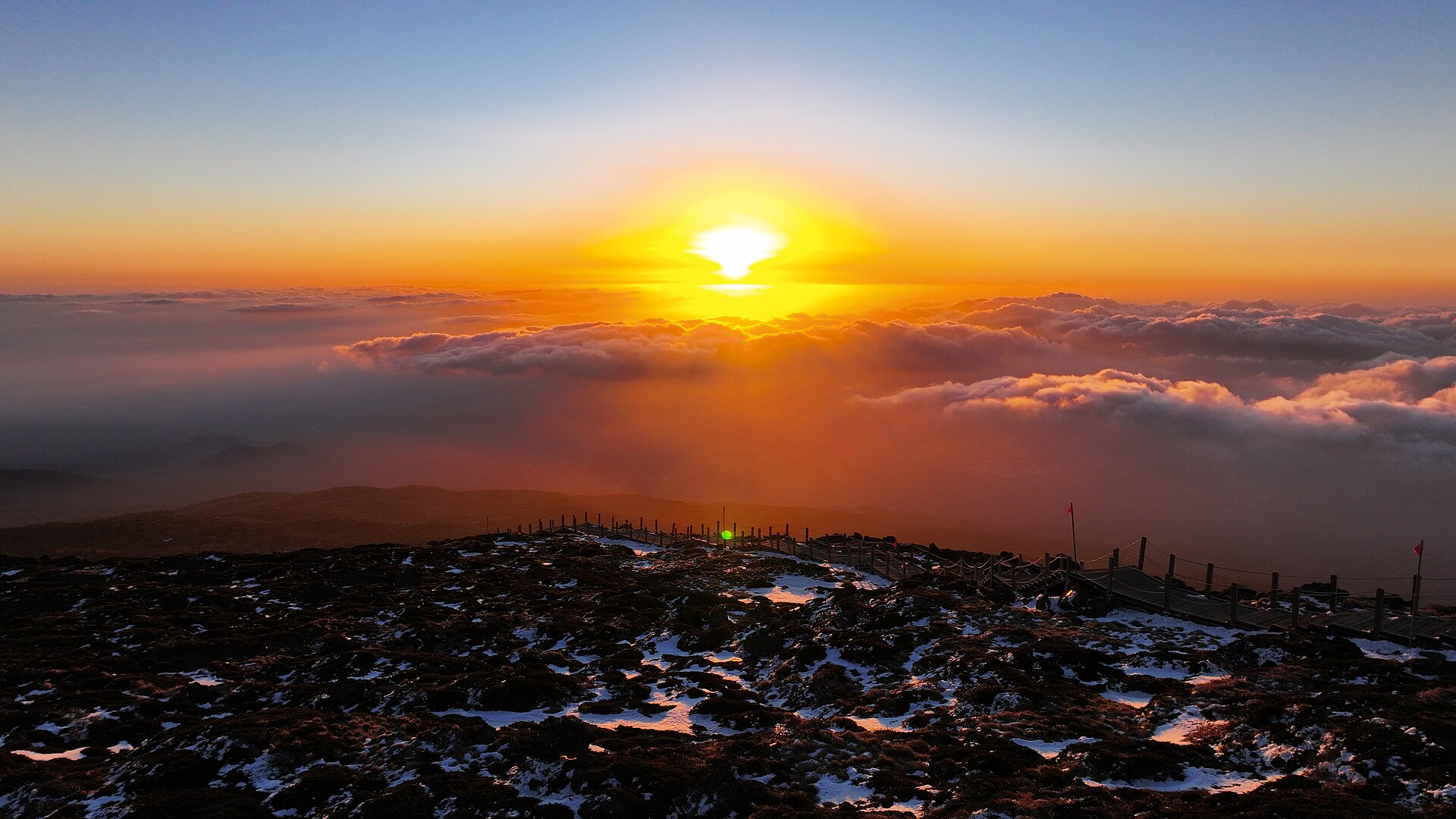
Yes. Winter is Hallasan’s best season if you come prepared. Snow and rime ice cover the crater and the stunted fir forest above 1,400 m, and you get a white mountain above a green, tangerine-growing coast. The best snow usually falls between late December and February, but the exact timing changes every year.
It’s also when most accidents happen. For 2026–27, the park is running winter safety checks from December 1 to March 31. Rangers at the trailheads check whether hikers have crampons (aijen in Korean) and strongly urge you to put them on when the trail is icy, according to the park’s November 2026 announcement. Strap-on chain spikes are enough for the main trails. The shop at the Gwaneumsa trailhead sells them, but buy a pair in Jeju City the day before rather than counting on finding them at dawn. Don’t try the summit in running shoes.
Two more winter points. The roads up the mountain, the 1100-ro road (Eorimok, Yeongsil) and the 5.16-ro road (Seongpanak), can ice over and close. Check before you drive, and take the bus if you’re not used to snow driving. Days are also short: there’s little daylight left after the shelters’ 3:30pm leave-by time, so carry a headlamp even on a day hike. If snowy landscapes are the point of your trip, our guide to Korea’s winter festivals lists more cold-weather highlights.
How do you get to the Hallasan trailheads without a car?
Two bus routes from Jeju Intercity Bus Terminal cover almost everything. These are the routes and approximate times from the park’s directions page:
- Seongpanak: bus 281 along the 5.16-ro road, about 30–40 minutes. It’s the easiest trailhead to reach, and the same bus continues to Seogwipo.
- Gwaneumsa: bus 281 to Jeju National University or Sancheondan, then change to bus 475 for about 15 minutes to the trailhead. A taxi from Jeju City takes about 30 minutes.
- Eorimok and Eoseungsaengak: bus 240 along the 1100-ro road, about 35–40 minutes.
- Yeongsil: bus 240, about 50–60 minutes, to the Yeongsil ranger office. From there it’s a 2.5 km (about 40-minute) walk up the access road to the real trailhead at the Yeongsil rest area. Only cars with fewer than 15 seats can drive that road.
- Donnaeko: about an hour from Jeju City, with a transfer in Seogwipo to buses 611 or 612.
Bus 240 runs about once an hour, so the one-way Yeongsil-up, Eorimok-down traverse works well by bus: both trailheads are on the same road. Check live times on the Jeju bus information system. If you’re driving, the trailhead car parks cost ₩1,000 for the first hour (the first 30 minutes are free), then ₩500 per 20 minutes, up to ₩13,000 a day for a small car. Seongpanak’s lot fills before dawn on winter weekends, and police ticket cars parked along the 5.16-ro road.
If you’d rather not juggle buses and early alarms, a guided Hallasan hike with hotel pickup🎟️ handles transport and the timing. It’s worth considering in snow season, when you’d otherwise be driving icy mountain roads in the dark.
A realistic summit-day plan
This plan, Seongpanak up and back in winter, gets an average hiker onto the summit with time to spare:
- The night before: sleep in Jeju City, check the trail status and forecast, and buy snacks, water and crampons. The shops at the old high-altitude shelters (Jindallaebat and Witse Oreum) have been closed since 2018. Seongpanak only has vending machines at the trailhead.
- 06:00–07:00: take the first 281 bus or a taxi to Seongpanak, scan your QR code and start walking.
- By 10:30: reach Jindallaebat shelter (aim for an hour before the 11:30 cutoff). Eat here, because you can’t eat on the summit. The shelters are the official meal spots, and you must carry out all your rubbish.
- Around 12:30: the Baengnokdam rim. Take your summit photo with location services switched on. The kiosks at Seongpanak and Gwaneumsa use it to print a summit certificate on the same day.
- By 13:30: leave the rim, as required. Allow 3.5–4 hours to walk down.
- Around 17:00: back at the trailhead, around sunset. That’s why a headlamp is in your pack.
If that schedule looks too tight for your group, the Yeongsil–Witse Oreum–Eorimok traverse takes about 4–5 hours with no booking. It still feels like a full Hallasan day.
What should you pack for Hallasan?
- Crampons or chain spikes from December to March. Rangers check for them.
- Layers and a windproof shell. The summit is often 10°C or more colder than the coast, and the wind across the plateau is strong.
- Water and food for the whole day. There’s nothing to buy on the mountain. The park allows gimbap and burgers but bans disposable lunch boxes. Ready-meal packs that heat themselves are allowed, but any heating pack used to boil water in a pot is not.
- Headlamp, gloves, hat and a charged phone with your QR code.
- Cash or a card for the trailhead kiosks and buses. Buses in Jeju also take T-money cards.
For comparison with the mainland’s big mountains, our Seoraksan National Park hiking guide covers Korea’s other famous peak, and the Bukhansan hiking guide is the one to read if you only have a half day in Seoul.
Fitting Hallasan into a Jeju trip
Give Hallasan its own full day, and put it early in your trip. If the weather closes the summit, you’ll have a spare day to try again. It also helps to have a rest day afterwards. A gentle coastal day, like the east-coast loop in our Jeju itinerary, is ideal for tired legs the next morning.
Where you sleep matters more than usual. Jeju City is closest to Seongpanak, Gwaneumsa and Eorimok, and it’s where both mountain bus routes start. Seogwipo works for Yeongsil and Donnaeko. Our guide to where to stay in Jeju compares the areas. If you’re still working on the trip, you can compare current fares to Jeju✈️. Most international travelers connect through Seoul, and the domestic hop takes about an hour.
After your hike, a slow stretch of the coastal Olle trail makes a good contrast with the mountain. Our Jeju Olle Walking Festival report explains how the routes work.
Disclosure: This post contains affiliate links. If you book through these links, I may earn a small commission at no extra cost to you. I only recommend services I’d use myself.