
Last Updated: June 2026
Quick answer: The easiest way of getting around Seoul is the subway, paid with a rechargeable T-money card — clean, cheap (about ₩1,400 a ride), and signed in English. Use buses for short hops, taxis via the Kakao T app late at night, and the KTX for trips beyond the city.
Getting around Seoul is one of the easiest parts of any trip to Korea. The city runs on a subway system that is clean, cheap, punctual, and signed in English — and once you have a single rechargeable card in your pocket, the buses, taxis, and trains all open up too. First-timers worry about the language and the size of the city, but in practice you can cross Seoul end to end for a couple of dollars without speaking a word of Korean.
This guide covers everything you need to move through the city with confidence: the subway, the all-important T-money card, buses, taxis, the ride from the airport, and the apps that tie it all together. Sort out the basics below and you’ll spend your trip sightseeing instead of staring at a transit map.
Table of Contents
- What’s the Best Way of Getting Around Seoul?
- How Does the Seoul Subway Work?
- Do You Need a T-money Card?
- How Do You Get from Incheon Airport to Central Seoul?
- Should You Take Taxis in Seoul?
- Are Seoul’s Buses Worth Using?
- Which Maps and Apps Do You Need?
- How Do You Travel Beyond Seoul?
- Seoul Transport Options at a Glance
- Practical Tips for First-Timers
- Plan Your Trip
What’s the Best Way of Getting Around Seoul?
For almost every visitor, the best way of getting around Seoul is the subway, paid for with a T-money card. The metro reaches nearly every place a first-timer wants to go, trains arrive every few minutes, and a typical ride costs around ₩1,400. Buy a T-money card the moment you land, top it up at any convenience store, and you’re set for the whole trip — buses and most taxis take the same card.
You’ll only need anything else in three situations: getting to and from the airport with luggage, short late-night hops when the subway has stopped, and day trips to other cities. Everything else is the metro.
How Does the Seoul Subway Work?
The Seoul subway works on more than 20 numbered, colour-coded lines, and you tap a card in and out at the gates to pay a distance-based fare. The Seoul Metropolitan Subway is one of the largest, best-run systems in the world — over 20 lines and more than 600 stations carrying upwards of 2 billion passenger trips a year — yet every station name, sign, and train announcement is in English as well as Korean, so navigating it is far simpler than it looks on the map.
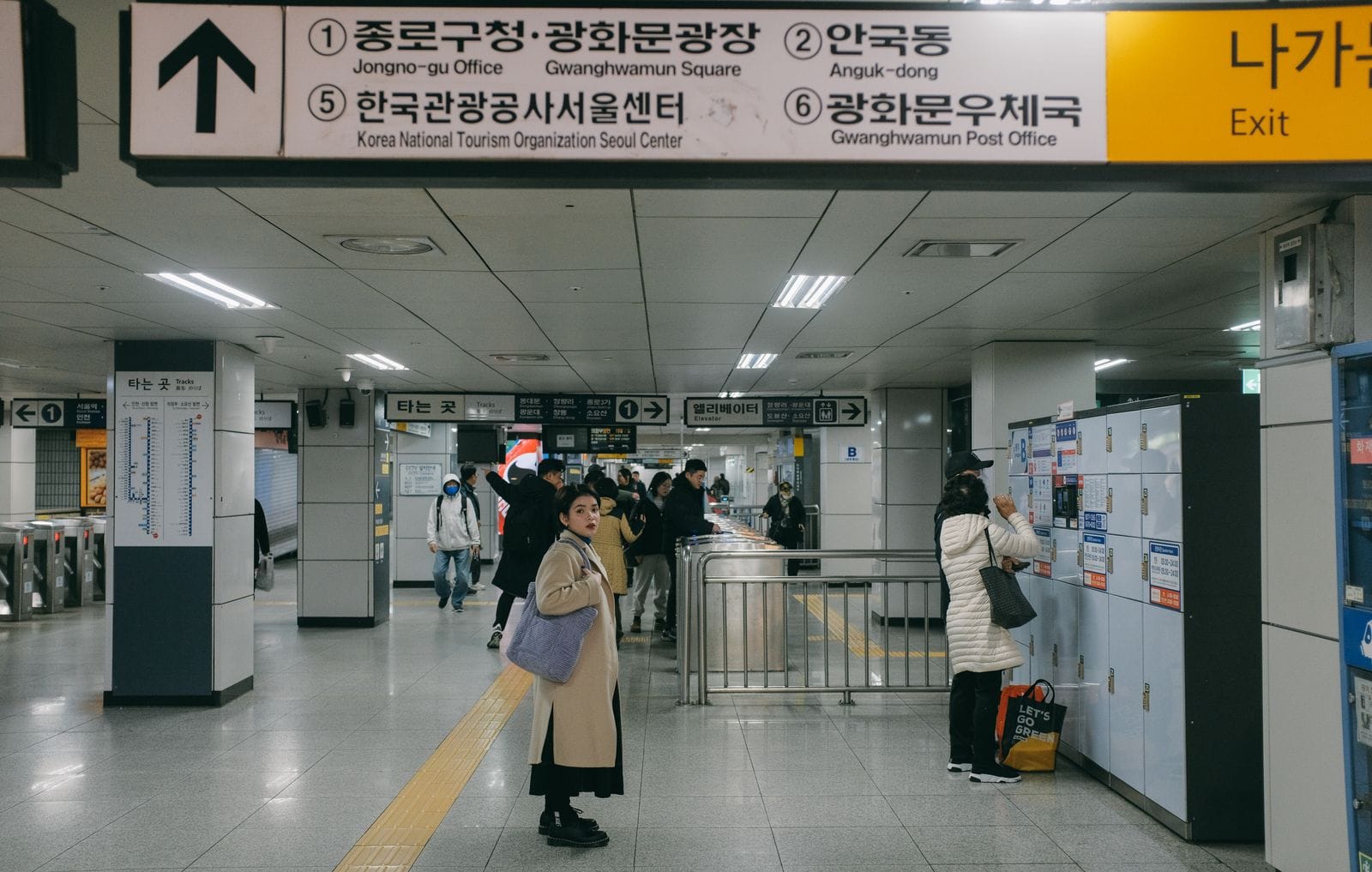
The basics: trains generally run from around 5:30 AM until midnight. Fares are distance-based but cheap — most journeys inside the city are ₩1,400–1,600, and you tap your card on the way in and again on the way out. Lines are known by number and colour (Line 2, the green loop line, connects many of the big sightseeing areas), and transfers between lines are well signposted with walking times.
A few first-timer notes. Trains can be packed during rush hour (roughly 8–9 AM and 6–7 PM), so avoid moving across the city with luggage then. Seats at the ends of each carriage are reserved for the elderly and pregnant — leave them free even when empty. And keep right on escalators; the left side is for walking.
Do You Need a T-money Card?
Yes — a T-money card is the one thing to sort out first. It’s a rechargeable transit card that works on every subway, bus, and most taxis across the country, and it makes each ride slightly cheaper than buying single-journey tickets. You tap in and out, top it up with cash at any convenience store or station machine, and at the end of the trip you can spend the leftover balance in convenience stores.
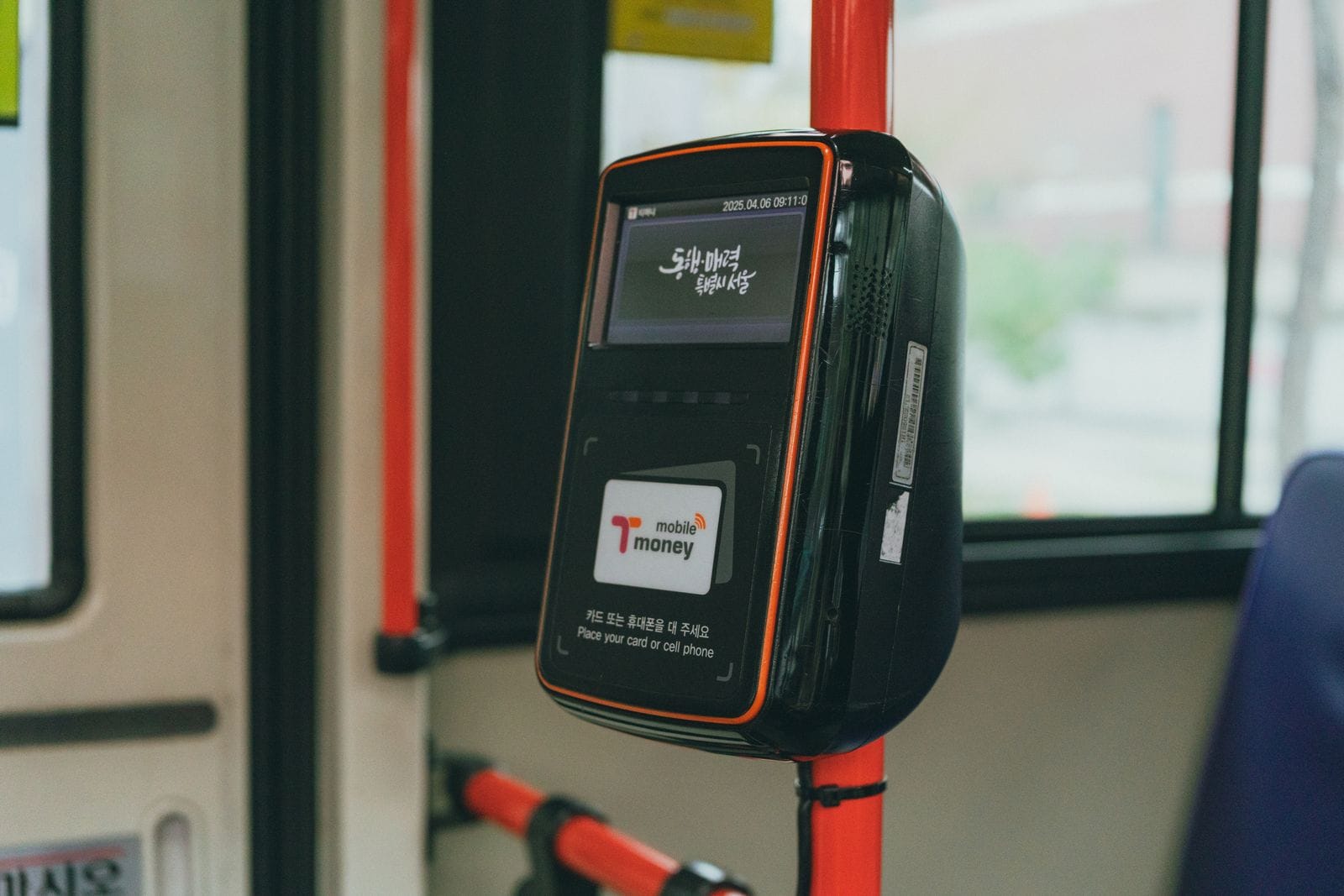
You can buy a T-money card at any subway station, convenience store, or airport kiosk for about ₩2,500–4,000 (the card itself is non-refundable, the balance is). If you’d rather have one waiting for you, it’s easy to pick up a pre-loaded transit card at the airport on arrival🎫 so you can walk straight to the train. One card per person — they can’t be shared on a single tap. If you’re weighing T-money against WOWPASS or the Climate Card, or want the wider picture on cash, cards, and currency exchange, see our money in Korea guide.
How Do You Get from Incheon Airport to Central Seoul?
Most visitors arrive at Incheon International Airport (ICN), about 50 km west of the city. The quickest, cheapest, and most reliable way in is the airport railroad — the AREX line. The Express train runs non-stop to Seoul Station in about 43 minutes; the All-Stop train takes a little longer but costs only around ₩4,500 and connects directly to the regular subway, so you can ride it most of the way to your hotel on the same T-money card. For a full breakdown of every route into the city, see our guide to getting from Incheon Airport to Seoul.
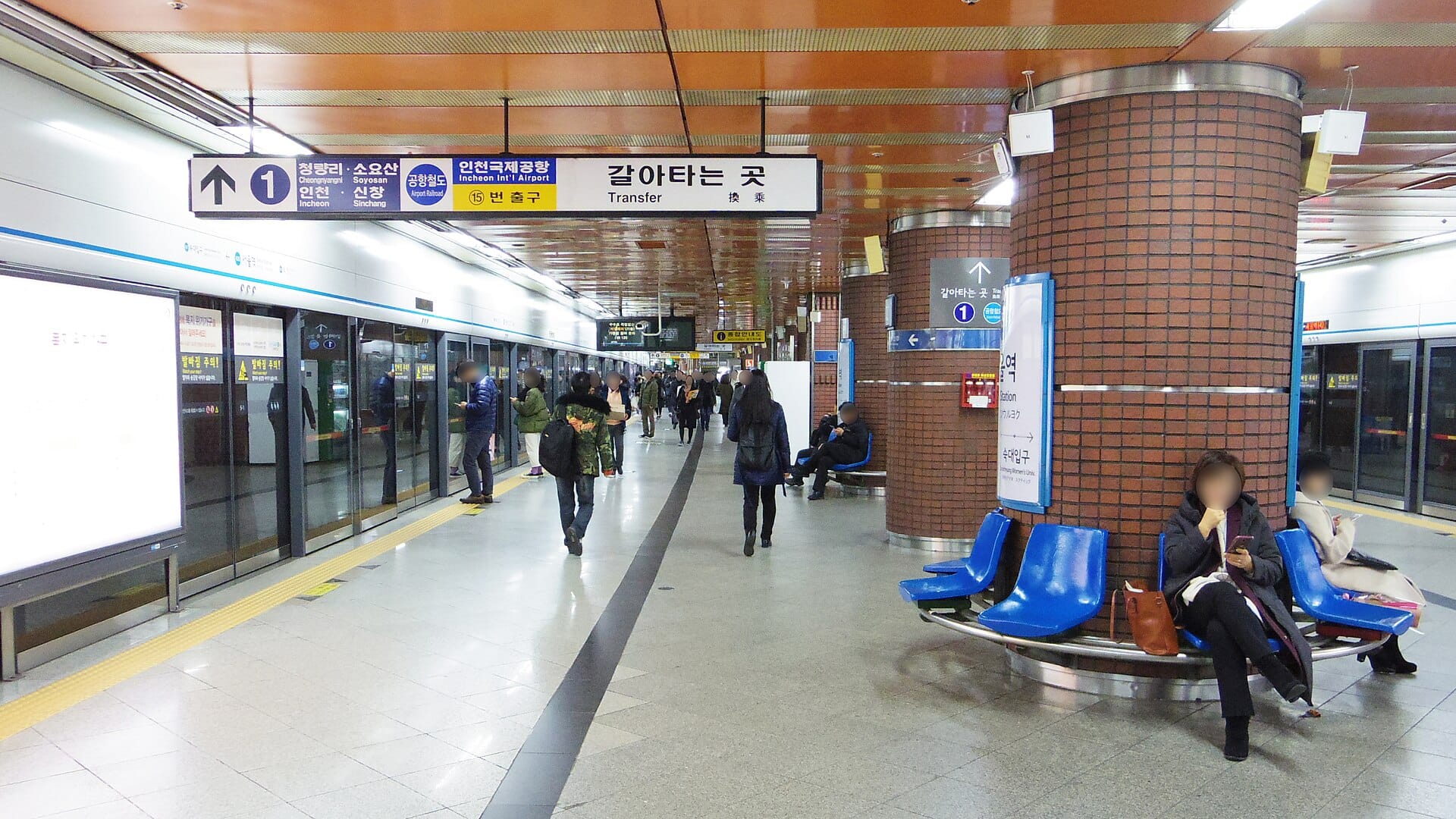
It’s worth booking the express airport train in advance🎫 if you’re landing late or simply want it sorted before you fly. The other options:
- Airport limousine bus. Comfortable coaches that run to most neighborhoods and stop near many hotels — the easiest choice if you have heavy luggage. Expect ₩16,000–17,000 and 60–90 minutes depending on traffic.
- Private transfer or taxi. The most door-to-door option, best if you’re arriving very late, traveling as a group, or staying somewhere awkward to reach. A private car can be arranged online before you land🎫; a metered taxi runs roughly ₩60,000–90,000 plus tolls.
Should You Take Taxis in Seoul?
Taxis in Seoul are clean, safe, and cheap by international standards — a short cross-town hop might be ₩6,000–10,000, which is well worth it when you’re splitting the fare or the subway has stopped for the night. The base fare starts around ₩4,800, with a late-night surcharge after midnight.
The easiest way to catch one is the Kakao T app, Korea’s equivalent of a ride-hailing service. It lets you set your destination on a map (no need to pronounce the address), calls a regular licensed taxi, and can charge your card automatically. Most taxis also accept T-money and credit cards, so you rarely need cash. Hailing on the street works fine too — a red light in the windscreen means the cab is free.
Are Seoul’s Buses Worth Using?
Buses fill the gaps the subway doesn’t reach and are handy for short trips up a hill or across a neighborhood — think the climb to N Seoul Tower or a hop between two areas on the same side of the river. They use the same T-money card: you tap as you board and again as you get off, which keeps transfers between bus and subway cheap.
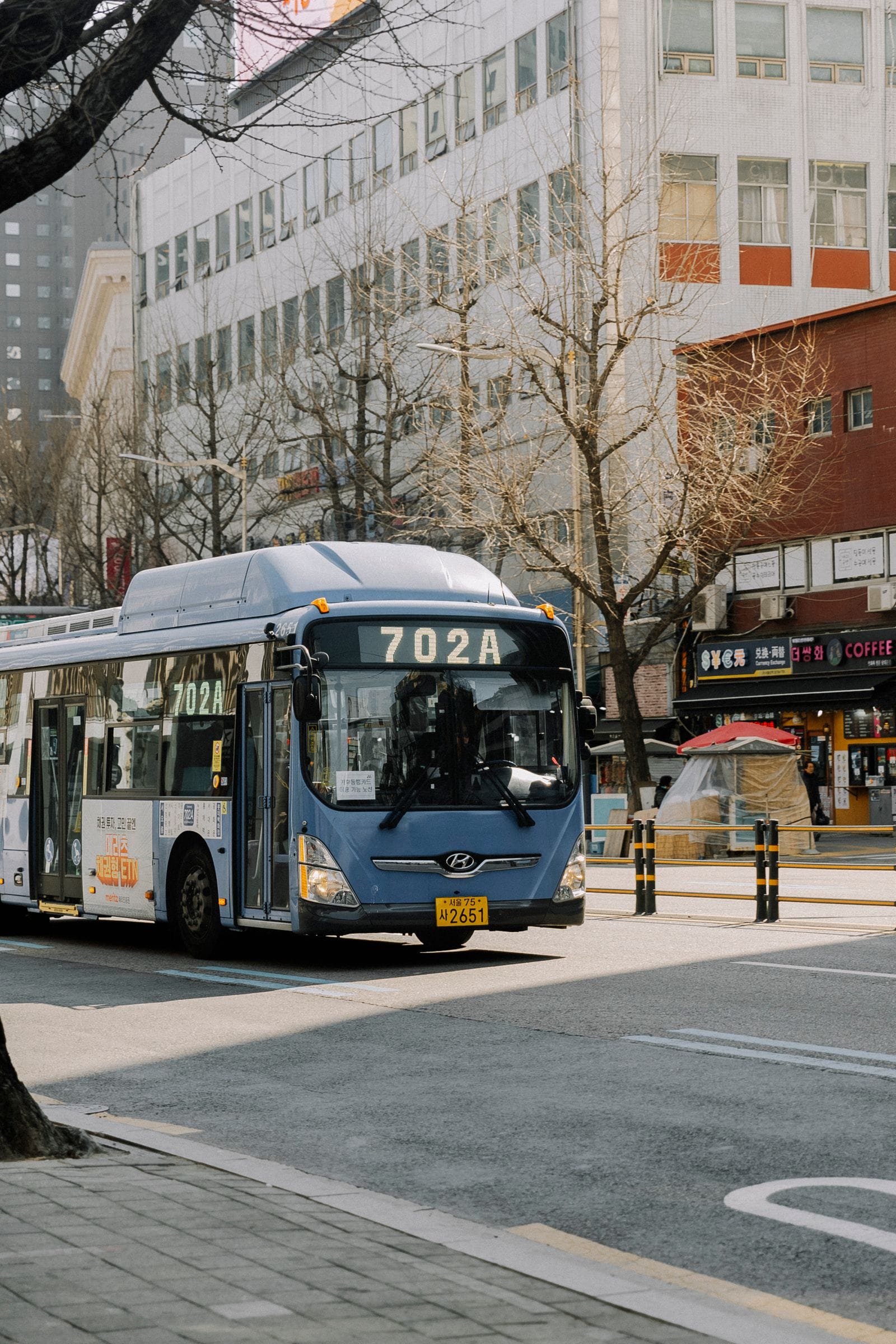
The catch is that bus stop signs and on-board announcements are less consistently in English than the subway, and the colour-coded routes (blue for long trunk routes, green for local feeders, red for express) take a little learning. For first-timers, the move is to let a maps app tell you which numbered bus to board and which stop to get off at — then buses become genuinely useful rather than intimidating.
Which Maps and Apps Do You Need?
Download two things before you arrive: a local maps app and a translation app. Google Maps walking and transit directions are unreliable in Korea because of mapping-data restrictions, so locals — and smart travelers — use Naver Map or KakaoMap instead. Both are in English, give accurate subway, bus, and walking routes door to door, and tell you which exit number to take (a small thing that saves a lot of time in Seoul’s huge stations).
For language, Papago handles Korean far better than Google Translate, including menu photos and signs. Add Kakao T for taxis and you have everything you need. To use any of them on the move you’ll want mobile data, so pick up a SIM, eSIM, or pocket WiFi at the airport or pre-book one online before you fly.
Two changes to know for 2026. The 30-day Climate Card merges with the K-pass on September 1 and becomes Climate Card Plus — short-trip visitors are unaffected, but the pass you read about last year is not the one you’ll buy. And on the express-rail side, GTX-A’s Samseong Station segment is delayed again, so Gangnam and Samseong still need the regular subway.
How Do You Travel Beyond Seoul?
If you’re adding a day trip or a second city, Korea’s high-speed trains make it easy. The KTX reaches Busan in about 2.5 hours and Gyeongju, Jeonju, or Daejeon in well under two — fast, comfortable, and far less hassle than flying domestically. Trains leave from Seoul Station and Suseo Station, and seats sell out on weekends and holidays, so it pays to reserve high-speed rail tickets ahead of time🚄.
For destinations without a rail link — the DMZ, Nami Island, coastal towns — a guided day tour with hotel pickup is usually the simplest option, since it bundles the transport and the logistics into one booking. Our roundup of the best day trips from Seoul covers where to go and how to reach each one. If your days in the city are still loose, our 4-day Seoul itinerary groups each day by area so you spend less time in transit and more time actually seeing the city.
Seoul Transport Options at a Glance
| Mode | Typical cost | Best for |
|---|---|---|
| Subway | ₩1,400–1,600 per ride | Almost everything — your default |
| Bus | ₩1,500 per ride | Short hops the subway misses |
| Taxi | ₩6,000–10,000 short trip | Late nights, groups, luggage |
| Airport train (AREX) | ₩4,500 all-stop | Airport ↔ city, cheaply |
| Airport bus / transfer | ₩16,000+ / varies | Door-to-door with luggage |
| KTX | From ~₩20,000 | Day trips and other cities |
Practical Tips for First-Timers
- Get your T-money card first. Buy one at the airport before you do anything else, and top it up with cash at any convenience store.
- Use Naver Map or KakaoMap, not Google. They give accurate routes and the exact station exit to use.
- Note the station exit number. Big stations have a dozen or more exits — coming out the right one saves a long detour.
- Avoid rush hour with luggage. Trains are packed 8–9 AM and 6–7 PM; move your bags outside those windows.
- Keep some cash for buses and small fares. Cards are widely accepted, but it’s handy to have a little on hand.
- Factor in the season. Summer’s monsoon rain and winter’s icy stairs both slow down walking transfers between exits — see our best time to visit Seoul guide for what each month is actually like.
- Stay near a subway station. Where you sleep decides your daily transit time — see our guide to where to stay in Seoul for the best-connected areas.
Plan Your Trip
Sort out transit on arrival. Have a transit card and airport train ready to collect🎫 waiting for when you step off the long-haul flight into Incheon✈️, so your first ride into the city is the easy one.
Consider a sightseeing pass. If you’ll visit several paid attractions, a multi-day Seoul pass🎫 bundles entry to many of them with a free airport-train ride onto one card.
Plan where you’ll sleep and what you’ll do. Pair this guide with our where-to-stay neighborhood breakdown and our 4-day Seoul itinerary — plus our guide to what to eat in Seoul — to keep every day short on transit and long on sightseeing.
Disclosure: This post contains affiliate links. If you book through these links, I may earn a small commission at no extra cost to you. I only recommend services I’d use myself.