
Last Updated: September 2026
Quick answer: Finding halal food in Seoul is far easier than most first-time visitors expect. The core of the scene is the streets around Seoul Central Mosque in Itaewon, where a dense cluster of Halal-Certified, Self-Certified, and Muslim-Friendly restaurants sits within a short walk of the mosque itself. Korea’s official Muslim-friendly directory (run by the Korea Tourism Organization) rates places into four clear tiers, so you can check a restaurant’s status before you sit down rather than guessing.
Korea isn’t a Muslim-majority country, and Korean cooking leans heavily on pork and on alcohol-based seasonings like soju and mirin — so it’s fair to go in with lower expectations than, say, Malaysia or Turkey. But the gap has closed quickly. This guide covers what Korea’s certification labels actually mean, where to eat, where to pray, and how to double-check a place before you order.
Table of Contents
- What Do “Halal Certified” and “Muslim Friendly” Actually Mean in Korea?
- Where Is Seoul’s Halal Food Neighborhood?
- Can You Get Halal Korean BBQ and Other Local Dishes?
- Where Can You Pray in Seoul?
- Is There Halal Food Outside Itaewon?
- How Do You Confirm a Restaurant Is Really Halal Before You Go?
- Tips for Muslim Travelers in Seoul
- Where to Stay Near the Mosque
- Plan Your Trip
What Do “Halal Certified” and “Muslim Friendly” Actually Mean in Korea?
The Korea Tourism Organization’s Muslim-friendly program sorts restaurants into four tiers, and knowing the difference matters more here than in most halal-food guides:
| Tier | What it means |
|---|---|
| Halal Certified | Certified by an accredited body — in Korea, almost always the Korea Muslim Federation (KMF). The strictest tier; ingredients and preparation are audited. |
| Self-Certified | The restaurant’s Muslim owner or chef declares the menu halal, without third-party audit. |
| Muslim Friendly | Some halal dishes are on the menu, but the kitchen also handles non-halal food and may serve alcohol. |
| Pork-Free | No pork on the menu, but not certified halal — soju, mirin, or other alcohol-based seasonings may still be used in sauces. |
KMF has certified halal food in Korea since 1994 and holds mutual-recognition agreements with several of the region’s own halal authorities, including Malaysia’s JAKIM, Indonesia’s BPJPH, and Singapore’s MUIS — useful context if you’re used to checking for one of those marks at home. The practical takeaway: a “Muslim Friendly” or “Pork-Free” label is not the same as halal-certified, so it’s worth reading the tier, not just the badge, before you decide what to order.
Where Is Seoul’s Halal Food Neighborhood?
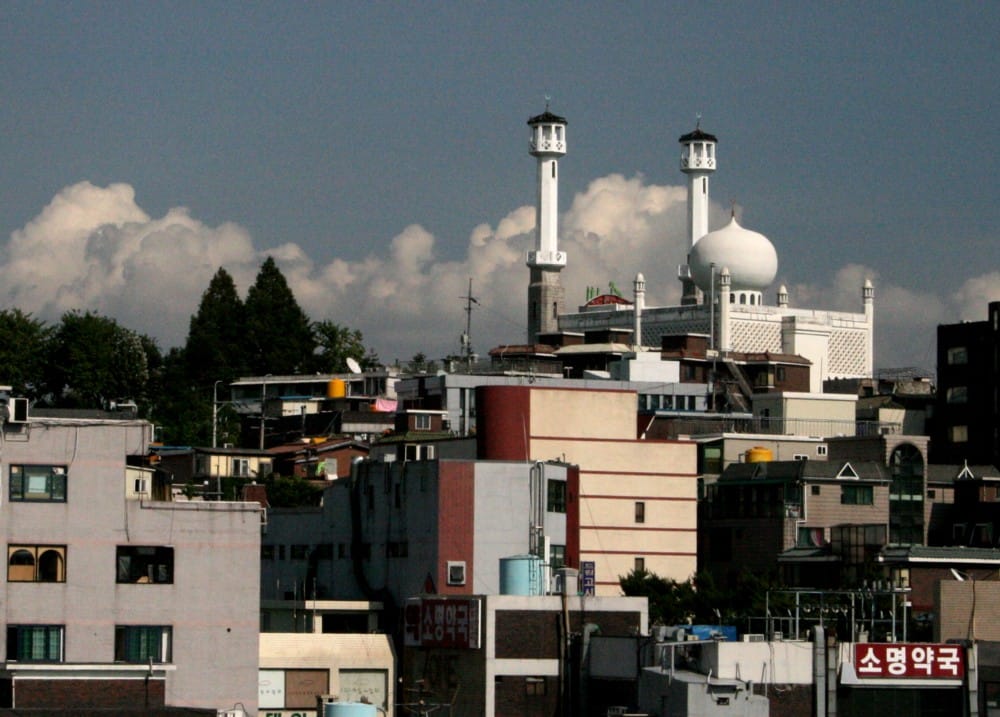
Almost every halal food trip in Seoul starts on Usadan-ro, the street climbing the hill behind Itaewon toward Seoul Central Mosque — travelers commonly call it “Muslim Street.” Within a few minutes’ walk of the mosque you’ll find Turkish, Pakistani, Indian, Middle Eastern, and Korean-halal-fusion kitchens stacked along the slope, along with a halal butcher, a halal grocery, and an Islamic bookstore serving the neighborhood’s resident Muslim community as much as visitors.
It’s the single most efficient place to eat if you want variety without hunting restaurant-by-restaurant across the city — you can walk the strip, check tiers on the KTO directory as you go, and pick whatever looks best. Nearby Hannam-dong and the wider Itaewon strip add a few more Muslim-friendly options for travelers who want to range slightly further from the mosque itself.
Can You Get Halal Korean BBQ and Other Local Dishes?
Yes, and it’s one of the more useful discoveries for a Muslim visitor who wants to actually taste Korean food rather than just international options near the mosque. Bulgogi (marinated grilled beef) and galbi (grilled short ribs) are naturally the easiest Korean dishes to halal-certify, since the base ingredient is beef or lamb rather than pork — the sticking point is usually the marinade, which traditional recipes season with soy sauce, sugar, garlic, and sometimes a splash of rice wine. A handful of kitchens around Itaewon and Usadan-ro now serve certified or self-certified halal versions of bulgogi, galbi, and bibimbap made without those alcohol-based seasonings, so it’s worth asking specifically for a halal Korean BBQ option rather than assuming it doesn’t exist.
Outside that handful of kitchens, standard Korean BBQ restaurants are a mixed bag: many grill pork alongside beef at the same table, and soju is a fixture of the meal, so cross-contact and alcohol both become real concerns. If a place isn’t listed as halal-certified or self-certified, it’s safer to treat “Korean BBQ” as a menu category to ask about rather than order from blind.
Where Can You Pray in Seoul?
Seoul Central Mosque opened in 1976 on a hilltop in Itaewon’s Hannam-dong and remains the city’s main hub for prayer — it has prayer halls on two floors, with separate ablution facilities for men and women in the annex building, and it welcomes non-Muslim visitors outside prayer times. It’s an easy walk from Itaewon Station (Line 6), and it’s the natural anchor point for planning a day around both prayer and food, since the restaurant cluster on Usadan-ro sits directly on the walk up to it.
Beyond the mosque, KTO’s Muslim-friendly program has worked with hotels and major venues to add multi-faith or prayer spaces — COEX Mall in Gangnam is a commonly cited example — and prayer mats and qibla compasses have been distributed to participating hotels. Coverage is still uneven outside Itaewon, so if a prayer room matters for your itinerary, it’s worth confirming with the specific venue (or your hotel’s front desk) rather than assuming one is available.
Is There Halal Food Outside Itaewon?
It’s thinner, but growing. Dongdaemun has picked up a small cluster of Central Asian and Middle Eastern restaurants tied to the area’s long-standing foreign shopping trade, and self-certified or Muslim-friendly options are gradually appearing in Myeongdong and Gangnam as more restaurants cater to Muslim tourists from Southeast Asia and the Gulf. None of these areas come close to matching Itaewon’s density yet, so if halal food is a priority for more than one meal a day, it’s worth building at least part of your trip around staying near Usadan-ro rather than expecting to find equivalent options wherever you happen to be.
How Do You Confirm a Restaurant Is Really Halal Before You Go?
Check the tier, not just the label. The KTO Muslim-friendly directory lists restaurants by city with their certification tier, and it’s the most current single source — restaurant status changes as certifications lapse or renew, so treat any list (including this one) as a starting point rather than gospel on the day of your trip. A few practical habits help on the ground:
- Look for the certificate. KMF-certified kitchens typically display a certificate near the entrance or register — it’s worth glancing for it rather than trusting a menu icon alone.
- Ask about the marinade, not just the meat. Korean sauces routinely use soju or mirin even in beef and seafood dishes — a kitchen can be pork-free and still not halal for that reason.
- Self-certified is still worth trying. It just means no third-party audit backs the claim — many self-certified kitchens are run by Muslim owners cooking to their own standard.
- When in doubt, stick to Halal Certified. If you’re strict about certification, filter the KTO directory to that tier specifically rather than “Muslim Friendly,” which can still include alcohol on the premises.
Tips for Muslim Travelers in Seoul
- Base yourself near Usadan-ro if food matters most. Staying within walking distance of the mosque means every meal is a short walk from a Halal-Certified or Self-Certified option.
- Stock up at the halal grocery near the mosque. It’s a reliable backup for snacks and staples on days you’re out sightseeing away from Itaewon.
- Confirm prayer facilities ahead of day trips. Coverage outside Itaewon is inconsistent, so check with your hotel or the specific venue before you need it.
- Travel during Ramadan? A few Itaewon restaurants run iftar-style evening offerings during the month — ask when booking, since hours can shift.
- Carry your dietary needs in Korean. A short written note (halal, no pork, no alcohol) smooths ordering anywhere outside the Itaewon cluster.
Where to Stay Near the Mosque
For the easiest access to both prayer and food, staying in or near Itaewon puts Usadan-ro and the mosque within walking distance for every meal. Our where to stay in Itaewon guide covers hotels within that radius, and the broader Itaewon neighborhood guide rounds out what else is worth doing in the area beyond the halal food strip.
Plan Your Trip
If you’re still settling on dates, it’s worth taking a look to compare current fares to Seoul✈️ before you lock in your trip.
Want the food and mosque visit handled for you on day one? A Muslim-friendly Seoul city day tour🎫 pairs the main sights with halal-certified stops and a mosque visit, which takes the guesswork out of a first day in the city.
For more on the wider food scene, see our guides to Korean street food in Seoul, what to eat in Seoul, and our full Korean BBQ guide for how the standard (non-halal) version of the meal works if you’re travelling with a mixed group.
Disclosure: This post contains affiliate links. If you book through these links, I may earn a small commission at no extra cost to you. I only recommend services I’d use myself.